
Precision POM Injection Molding for Engineering Components
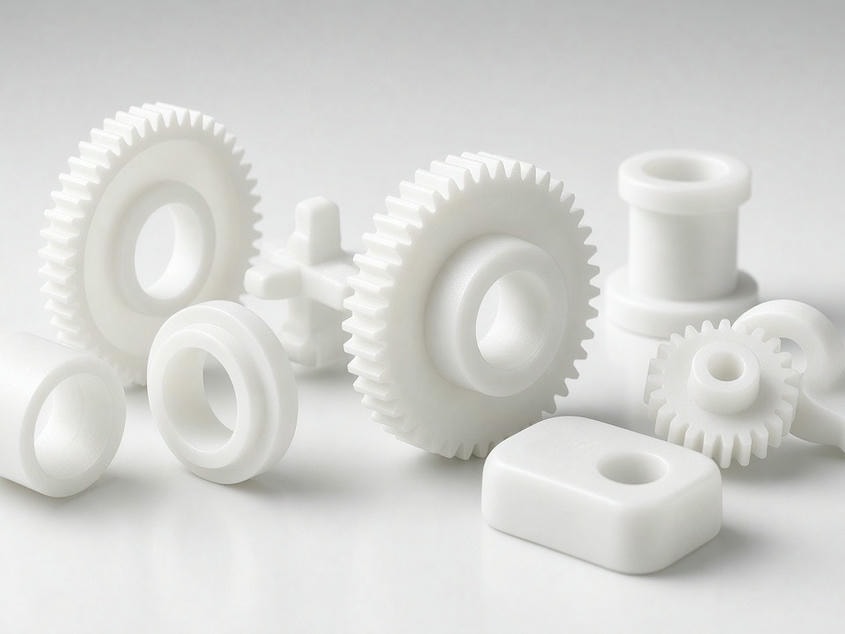
POM, also known as Acetal, is the industry standard for precision mechanical parts where dimensional stability and low friction are critical. PPMolding processes engineering-grade POM resins for stable, functional, production-ready components.
From gear assemblies and snap-fit housings to high-wear industrial components, our team translates your CAD designs into reliable molded parts.
50–1,000
Ton machine range
±0.05 mm
Typical tolerance
-40 to 100°C
Operating range
Material expertise
Why POM is chosen for precision mechanical parts
POM is a high-crystallinity thermoplastic with high stiffness, low friction, fatigue resistance, and resistance to chemical exposure. These properties make it well suited to moving and load-bearing components.
Unlike commodity plastics, POM requires deliberate control of shrinkage, melt temperature, cooling rates, gating, and runner design. Our engineering process accounts for these factors before production begins.
Discuss your material requirementsShrinkage control
High POM shrinkage is addressed during mold design so final dimensions align with your specifications.
Thermal management
Melt temperatures and cooling rates are managed to reduce voids and warpage in thicker sections.
Tooling optimization
Gate locations and runner systems are designed for uniform filling and consistent wall thickness.
Material reference
POM material properties and applications
We work with both homopolymer and copolymer POM grades to meet specific mechanical requirements across precision mechanical applications.
| Property | Typical value | Manufacturing relevance |
|---|---|---|
| Tensile strength | 60–70 MPa | High load-bearing capacity |
| Flexural modulus | 2,500–2,800 MPa | High stiffness for structural parts |
| Coefficient of friction | 0.15–0.30 | Excellent self-lubricating properties |
| Operating temperature | -40°C to 100°C | Resists heat and cold cycling |
| Typical parts | Gears, bearings, valves, clips, fasteners | Precision mechanical components |
From tooling to production
Manufacturing control for stable POM parts
PPMolding supports projects from initial tooling development through high-volume production, with machines ranging from 50 to 1,000 tons.
Precision mold making for POM
We build molds with P20, 718, H13, and S136 steels for the durability required in long-term production.
- ✓Optimal gating: Minimize flow marks and stress concentrations.
- ✓Cooling channel layout: Promote uniform cooling and reduce warpage and internal stress.
- ✓Precision venting: Help prevent gas traps and surface defects in high-crystallinity materials.
Consistency from batch to batch
Stable production environments and documented process controls help maintain functional and dimensional consistency.
- ✓Drying protocols: Thorough material preparation helps prevent hydrolysis and surface defects.
- ✓Process monitoring: Track injection pressure, speed, and cooling cycles in real time.
- ✓Dimensional verification: Sample and measure production parts to maintain typical tolerances of ±0.05 mm.
Complete component support
Secondary operations and assembly
Go beyond the raw molded part with services that deliver components ready for your assembly line.
Insert molding
Integrate metal threaded inserts or pins directly into the POM part for improved structural integrity.
CNC machining
Add tight-tolerance holes, specific undercuts, and other features that cannot be molded.
Assembly
Combine multiple components through ultrasonic welding, heat staking, or manual assembly.
Surface finishing
Apply pad printing, laser marking, or painting for branding and identification.
Engineering partnership
A supplier equipped for POM projects
POM requires a different approach from ABS or PP. We focus on the shrinkage and thermal behavior that affect precision mechanical parts.
Practical engineering support
We review 3D files before tooling begins to identify issues such as uneven wall thickness or improper draft angles.
Clear communication
Receive updates on mold progress, trial results, and production schedules throughout the project.
Flexible volumes
Scale from prototype runs for design validation to multi-thousand-piece production runs.
Common questions
Planning a POM injection molding project?
Start your project
Turn your POM design into a production-ready component
Send your project details for a review of design, material requirements, production volume, and tooling considerations.
Email: info@plasticpartsmolding.com
Address:
Required information: 3D model, material specification, estimated annual volume, and surface finish requirements.