
Custom Plastic Overmolding Services
Combine rigid substrates with soft-touch or protective materials to create stronger, more comfortable, and more functional products in one cohesive component.
At PPMolding, we help product engineers and designers develop overmolded parts for ergonomic handling, non-slip performance, vibration damping, impact protection, and watertight sealing.
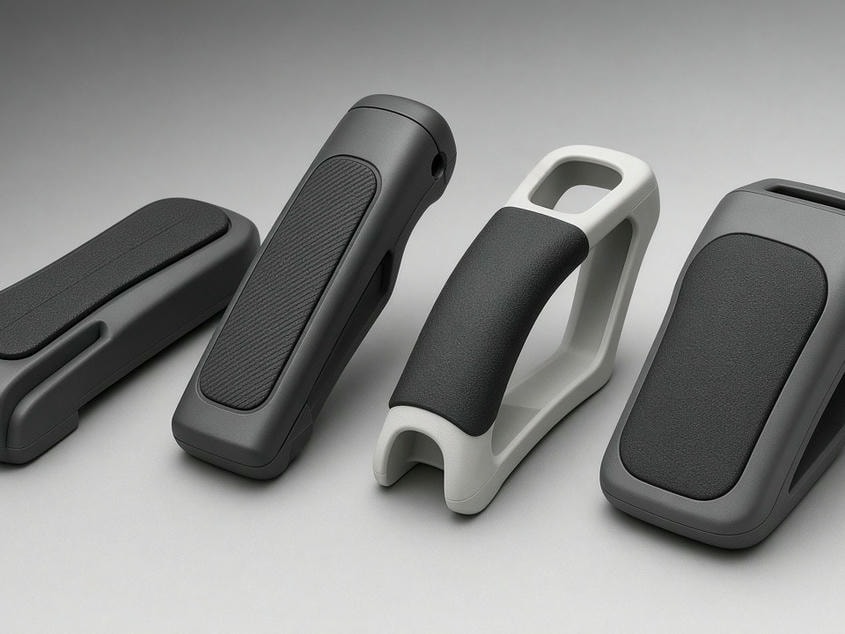
Design value first
Turn material combinations into product advantages
Overmolding eliminates separate assembly steps while adding purposeful functionality exactly where the product needs it.
Ergonomic control
Soft-touch TPE or TPU surfaces improve grip comfort and tactile feedback on handheld products.
Protection and sealing
Integrated gaskets and protective layers help support watertight, impact-resistant product designs.
Vibration reduction
Elastomer layers absorb vibration and impact in tools, controls, medical devices, and industrial equipment.
Fewer assembly steps
A unified molded component can reduce labor, improve consistency, and strengthen the finished assembly.
Manufacturing capabilities
Built around the bond between materials
We manage the complete overmolding process, from rigid substrate molding through the secondary TPE or TPU shot. Our production environment supports both soft-on-hard and hard-on-hard applications.
Machine capacity from 50 to 500+ tons supports development runs and scaled production programs.
Material bonding
Strong adhesion between PC, ABS, PA, and other rigid plastics and elastomers such as TPE or TPU.
Precision tooling
Custom molds support two-step molding cycles and accurate registration of the overmolded feature.
Integrated assembly
Plastic or metal inserts and electronic sub-assemblies can be integrated into the production workflow.
Overmolding parameters
A practical starting point for material and product planning
Final recommendations depend on geometry, bonding requirements, cosmetic targets, and production conditions.
| Parameter | Typical capability |
|---|---|
| Base material | ABS, PC, PC/ABS, PA, PP, PBT |
| Cover material | TPE, TPU |
| Material combinations | Soft-on-hard and hard-on-hard molding |
| Color schemes | Custom colors, including Pantone and RAL references |
| Surface effects | Smooth, matte, textured |
| Application areas | Electronics, consumer products, medical devices, automotive controls, industrial tools |
| Production quantity | Prototype to mass production |
| Typical products | Grips, seals, housings, knobs, buttons, switches, protective layers |
| Machine size | 50–500+ tons |
| Insert components | Plastic and metal inserts |
Design for manufacturing
Resolve overmolding risks before steel is cut
Overmolding is sensitive to geometry, material compatibility, and flow. Our engineering team reviews CAD files early to reduce the risk of delamination, flash, incomplete coverage, and development delays.
Typical applications
One process, multiple product experiences
Electronic housings
Gaskets and seals for IP-rated protection.
Consumer products
Ergonomic soft-touch grips for handheld devices.
Medical devices
Biocompatible materials and precise surface finishes.
Automotive controls
Knobs, buttons, and switches with tactile feedback.
Industrial tools
Protective layers for vibration reduction and impact resistance.
Project review
Bring your overmolding concept to production
Whether you have a completed 3D model or are still selecting materials, our team can provide a manufacturing feasibility assessment and detailed quotation.
Please include in your inquiry
- 013D CAD files, preferably STEP or IGS format.
- 02Material requirements for the substrate and overmolded layer.
- 03Estimated annual volume or batch size.
- 04Surface finish and cosmetic requirements.
Email: info@plasticpartsmolding.com
Facility address:
Start your quote request
Share your requirements and project files with our engineering team.