
Custom Plastic Injection Molding for Production-Ready Parts
PPMolding supports product developers, mechanical engineers, and procurement teams from DFM analysis and material selection through mold development, trial molding, mass production, and assembly.
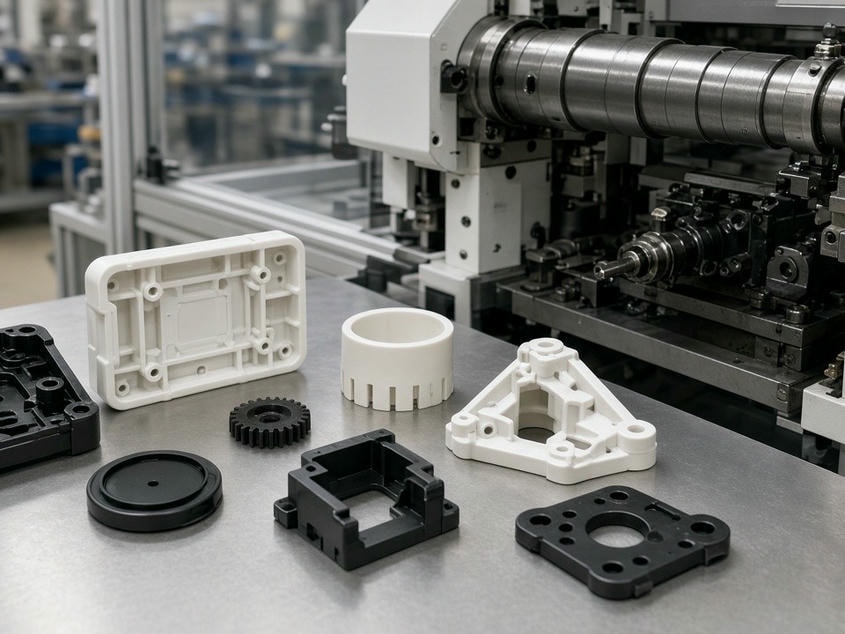
Structured engineering reviews help reduce tooling risk, stabilize production, and protect your launch schedule.
Why partner with us
Built around manufacturing stability, not just mold production
Our process connects engineering decisions, tooling, production control, and finishing services so your components remain consistent from first article through high-volume delivery.
Engineering-led DFM
Review wall thickness, draft, radii, gates, ejection, and likely molding risks before steel is cut.
Material guidance
Select resins according to mechanical, thermal, chemical, appearance, and compliance requirements.
Scalable tooling
Use single-cavity, multi-cavity, or family molds with hot or cold runner systems matched to volume goals.
Production continuity
First-article inspection, dimensional checks, secondary operations, and assembly support help protect batch consistency.
Manufacturing capabilities
Plastic injection molding parameters for different production needs
From low-volume prototypes to high-volume programs, our equipment and tooling options are configured around part complexity, annual demand, and quality requirements.
| Specification | Capability |
|---|---|
| Process | Thermoplastic injection molding |
| Machine tonnage | 50–1,000 tons |
| Material range | ABS, PC, PC/ABS, PP, PE, PA, POM, PMMA, PBT, PPS, TPU, TPE, PEEK, and other engineering plastics |
| Part weight | 1 g–5 kg |
| Product size range | Small precision parts through large, complex industrial housings; project-dependent |
| Mold types | Single-cavity, multi-cavity, and family molds; hot or cold runner systems |
| Mold cavities | 1–64 cavities |
| Typical tolerance | ±0.05 mm typical, depending on geometry, resin, and drawing requirements |
| Production quantity | 100–1,000,000+ parts |
| Surface treatment | Mold polish, SPI finishes, textures, painting, printing, and other project-specific finishing |
| Secondary operations | Printing, painting, ultrasonic welding, and full product assembly |
| Tooling lead time | 3–6 weeks for standard tooling, depending on complexity and cavity count |
| Mold life | 100,000–1,000,000+ shots |
From concept to production
A controlled path from 3D model to repeatable output
Each stage is connected to the next, allowing technical risks, material decisions, tooling requirements, and delivery expectations to be addressed early.
Start a Project ReviewEngineering and DFM review
We analyze CAD files and application requirements, identifying risks around wall thickness, draft angles, gate locations, ejection, and part geometry before tooling begins.
Material selection
We match resin performance to the part’s mechanical, thermal, chemical, appearance, and operating requirements across commodity and engineering-grade plastics.
Mold development and trial molding
Single-cavity, multi-cavity, or family molds are developed with high-grade tool steel and an appropriate runner system. Trial parts are evaluated before production release.
Injection molding, inspection, and assembly
Our 50–1,000 ton press capacity supports consistent dimensions and surface quality, followed by first-article inspection, ongoing dimensional checks, finishing, and assembly where required.
Applications
Manufactured for demanding product environments
We support teams that need functional, cosmetic, and precision plastic components for both new product development and established production programs.
Electronics
Housings, enclosures, and internal connectors.
Automotive
Structural components and functional interior parts.
Industrial and robotics
Precision parts for automation equipment and machinery.
Medical
Components for diagnostic and laboratory equipment.
Consumer goods and appliances
Cosmetic and functional parts requiring specific surface finishes and textures.
Design guidance
Design considerations that improve moldability
Addressing these factors during product design helps reduce cosmetic defects, ejection problems, warpage, and unnecessary tooling changes.
Uniform wall thickness
Maintain consistent walls where possible to reduce sink marks, uneven cooling, and warpage.
Draft angles
Typically allow 0.5° to 2° of draft to support clean part ejection from the mold.
Radii and fillets
Avoid sharp corners where possible; fillets reduce stress concentrations and improve material flow.
Surface finish
Define SPI finish or texture early because it affects polishing, appearance, and tool life.
FAQ
Common questions about plastic injection molding
Ready to start?
Send your CAD files for a technical review and quotation
Share your product requirements, target volume, material preferences, and delivery expectations. Our team can help identify the right path from DFM through stable production.
Recommended files: STEP, IGES, XT, and 2D drawings with tolerances
Helpful details: annual volume, resin, finish, assembly, and target schedule