
Plastic Material Selection Guide
Choose the right resin for strength, durability, thermal performance, chemical resistance, and cost. PPMolding helps engineering and procurement teams match application requirements with the most suitable thermoplastic materials.
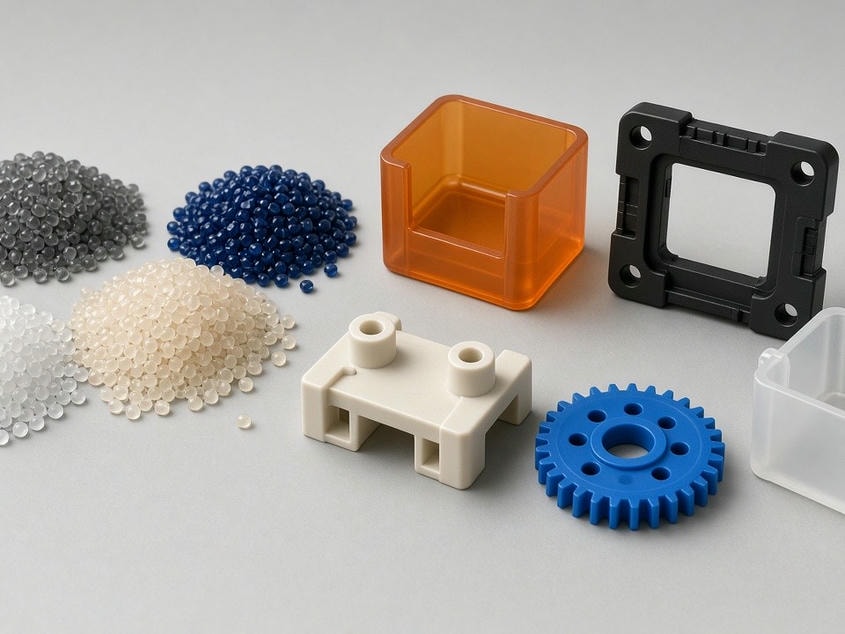
Compare plastic material properties
Use this overview to narrow your selection. Final resin recommendations should also account for geometry, processing conditions, environment, and regulatory requirements.
| Material | Strength | Heat resistance | Cost | Key applications |
|---|---|---|---|---|
| ABS | Moderate | Low | Low | Enclosures, consumer goods, housings |
| PC | High | High | Medium | Transparent covers, high-impact parts |
| PC/ABS | High | Medium | Medium | Automotive interiors, electronic housings |
| PP | Low–moderate | Low | Low | Containers, living hinges, chemical-resistant parts |
| PA (Nylon) | High | Medium | Medium | Gears, clips, structural fasteners |
| POM | High | Medium | Medium | Precision mechanical parts, bearings |
| TPE/TPU | Flexible | Low | Medium | Overmolding, gaskets, soft-touch grips |
| PEEK | Very high | Very high | High | High-performance industrial and medical components |
Material behavior matters in the mold
The correct resin must perform in the finished product and process consistently during injection molding. These common materials each bring different design and processing considerations.
From resin procurement to finished components
PPMolding manages the full production cycle with equipment and secondary processing options for prototypes, production parts, and complex multi-material assemblies.
Machine tonnage
Supports part weights from 1 g to 5 kg across varied production requirements.
Tolerance control
Standard tolerances, with tighter controls available for precision mechanical components.
Surface finishes
Textured, polished, or matte finishes to match functional and aesthetic requirements.
Multi-material molding
Insert molding and overmolding can reduce assembly steps and improve part functionality.
Assembly
Ultrasonic welding, heat staking, and mechanical fastening.
Surface finishing
Pad printing, screen printing, laser marking, and painting.
Machining
CNC secondary operations for features that cannot be molded directly.
Select the resin and geometry together
A material that performs well in a simple block may fail in a complex housing with thin walls and deep ribs. Our engineering team reviews CAD files before steel is cut to reduce iterative changes and accelerate time-to-market.
Request a DFM reviewWall thickness
Maintain uniformity to help prevent sink marks and warpage.
Draft angles
Facilitate part ejection, protect the mold, and reduce cycle times.
Gate location
Optimize material flow and minimize visible cosmetic defects.
Shrinkage compensation
Account for material-specific contraction during cooling.
Support from prototype to mass production
Production planning adapts to your product lifecycle, volume, tooling strategy, and quality requirements.
Prototype and bridge tooling
Cost-effective tooling solutions support low-volume production and design validation, allowing rapid iterations without the upfront cost of mass-production molds.
Mass production
Multi-cavity hardened steel molds, including P20, 718, H13, S136, and NAK80, deliver durable tooling and consistent high-speed output.
Get a material recommendation and manufacturing quote
Send your project documentation to info@plasticpartsmolding.com. If you are unsure about the resin, share the application details and our team will recommend a practical option for performance and cost.
Please provide
- 1. 3D CAD files: STEP, STP, IGES, or X_T preferred.
- 2. Material requirements: For example, outdoor use, transparency, or high impact.
- 3. Estimated annual volume: Helps determine the most cost-effective mold configuration.
- 4. Secondary requirements: Printing, assembly, or special packaging needs.
Tell us about your application
Share your requirements with the manufacturing team. We will evaluate your design and prepare a quote tailored to your project.
PPMolding