
Custom Insert Molding Services
PPMolding combines metal or secondary materials with engineered plastics in one repeatable molding process. The result is a robust, single-piece component designed to improve strength, reliability, and production efficiency.
±0.05 mm
Typical tolerance
50–500+
Machine tonnage
Prototype to mass production
Production support
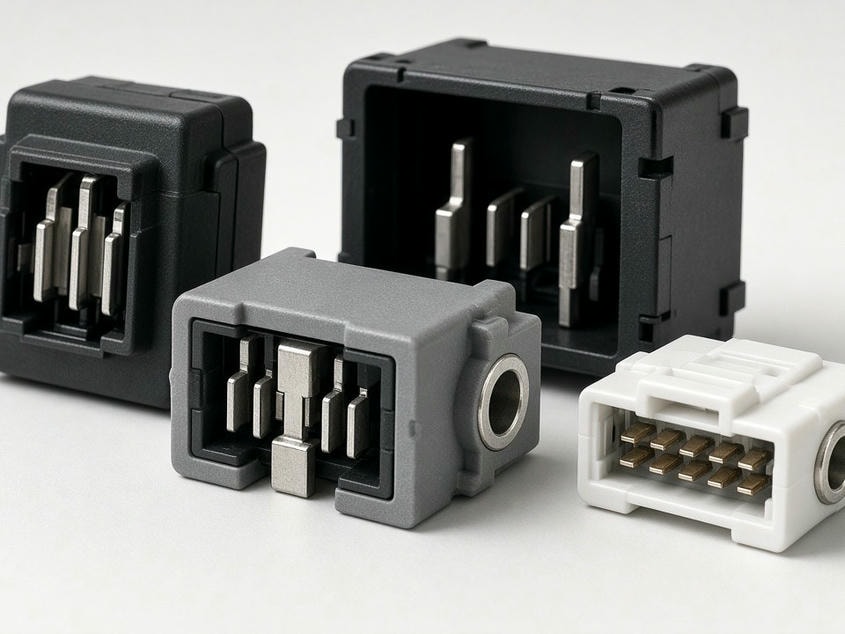
Built for demanding assemblies
Integrate threads, contacts, pins, bushings, or magnets directly into molded plastic components.
Process capability
A durable bond formed inside the mold
By positioning inserts in the mold cavity before injection, molten plastic flows around the insert and creates a mechanically retained, integrated part. This approach is well suited to applications requiring high mechanical strength, electrical conductivity, or precise positioning.
Engineering focus
Our process is controlled to protect the insert, maintain dimensional consistency, and preserve the integrity of the surrounding plastic.
| Parameter | Capability details |
|---|---|
| Process | Plastic insert molding |
| Machine size | 50–500+ tons |
| Insert materials | Brass, steel, stainless steel, aluminum |
| Plastic materials | ABS, PC, PA, PBT, PP, POM, PPS, PEEK |
| Insert types | Threaded inserts, pins, contacts, bushings, magnets |
| Insert size range | Project-specific; reviewed during design feasibility |
| Loading method | Manual or automated, depending on volume |
| Tolerance | Typically ±0.05 mm |
| Production volume | Prototype to mass production |
| Secondary operations | Machining, assembly, testing |
| Typical applications | Automotive, electronics, medical, industrial controls, power tools |
Why insert molding
More strength with fewer assembly steps
Directly integrating the insert into the molding cycle can simplify the part architecture while supporting demanding mechanical and electrical requirements.
Enhanced structural integrity
Plastic flows around the insert to create a mechanical bond that can be stronger than press-fitting or gluing.
Reduced assembly cost
Combine multiple components in one molding cycle and reduce secondary operations such as welding, staking, or fastening.
Improved reliability
Permanent integration helps prevent loosening caused by vibration, thermal expansion, or lifecycle stress.
Flexible material design
Use high-strength metal features inside lightweight plastic housings to balance durability, weight, and function.
Design for manufacturing
Design details that protect the insert and the mold
Early engineering collaboration helps manage injection pressure, cooling behavior, insert retention, and dimensional performance.
- ✓
Insert retention
Use knurling, undercuts, grooves, or other features to create a mechanical lock with the plastic.
- ✓
Wall thickness
Allow sufficient plastic around the insert to reduce hoop stress and cracking during cooling.
- ✓
Draft and gate placement
Provide adequate draft for ejection and position the gate to limit insert displacement or damage.
- ✓
Material and tolerance review
Account for the different thermal expansion behavior of metal and plastic when setting tolerances.
Typical workflow
Mold design
Secure the insert in the correct orientation and account for injection pressure.
Insert preparation
Inspect and load inserts manually for low volume or automatically for high volume.
Injection, cooling, and ejection
Encapsulate the insert, control cooling, minimize residual stress, and eject the part.
Quality inspection
Verify dimensions and perform pull-out force testing when required.
Application fit
Where insert molding adds value
The process supports components that need integrated strength, conductive features, or repeatable positioning across a broad range of industries.
Automotive
Connectors, sensor housings, and structural clips.
Electronics
Electrical contacts, terminals, and switches.
Medical equipment
Precision housings, surgical tool components, and diagnostic device parts.
Industrial controls
Threaded plastic housings, bushings, and shafts.
Power tools
Internal structural components and reinforced handles.
Engineering questions
Practical guidance for your design review
How are inserts retained during injection? +
The mold is designed to hold the insert in the required orientation while features such as knurling, grooves, or undercuts help the plastic form a mechanical lock around it.
Can insert molding support prototypes and high-volume production? +
Yes. Loading may be manual for lower-volume work and automated for higher-volume production, with support from prototype through mass production.
What should be included in a feasibility review? +
Share your 3D CAD files, insert material and geometry, plastic selection, target volumes, tolerance requirements, and any testing or secondary operation needs.
Start your project
Bring your insert molding design to production
Whether you are developing a prototype or preparing for full-scale production, PPMolding can review your design for manufacturability, process fit, and quality requirements.
Contact the engineering team
Share your project requirements, drawings, or specifications for a detailed response.
Email: info@plasticpartsmolding.com
Address: