
High-volume injection molding for OEM production
High-Volume Injection Molding Services for Scalable Production
PPMolding specializes in high-volume injection molding for OEMs and product manufacturers that require millions of consistent, high-quality plastic components. We balance cycle time, material efficiency, and tool longevity to support stable supply chains.
100,000–10M+
Annual parts volume
2–64+
Mold cavity options
24/7
Continuous production capability
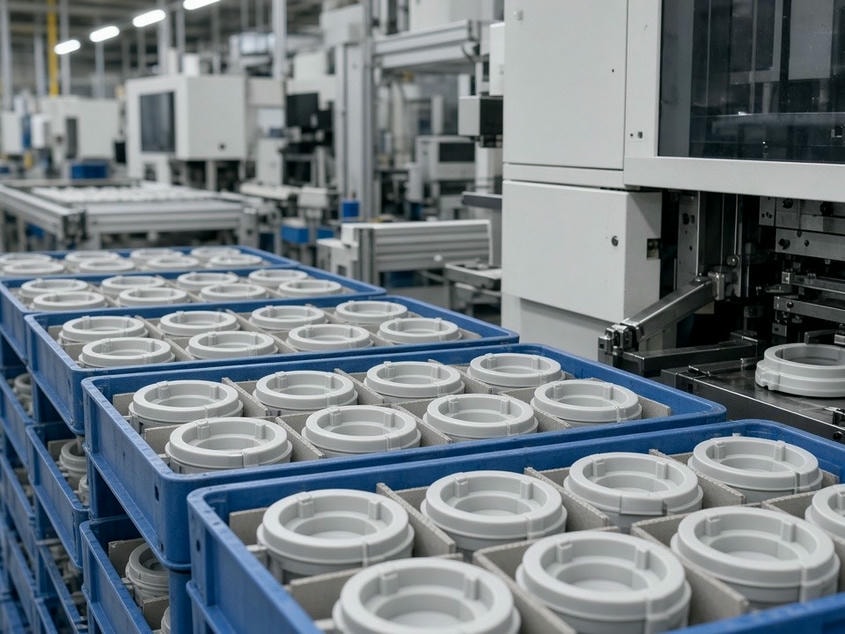
Built for repeatable production
Integrated tooling, automation, process control, and quality inspection reduce variance across millions of cycles.
Industrial-scale manufacturing
A production system designed for repetition
High-volume production requires more than a molding machine. Our approach connects mold design, material handling, automation, and process control to minimize variance across millions of cycles.
Multi-cavity molds and hot runner systems help reduce energy consumption and material waste while supporting a lower unit cost. Continuous production schedules help keep inventory consistent and reduce the risks associated with frequent setup changes.
Discuss your forecast and tooling strategyMulti-cavity tooling
Configure 2–64+ cavities to align output with annual demand and cost-per-part objectives.
Stable cycle control
Optimize cooling, runners, and process parameters for consistent cycle performance and dimensional accuracy.
Automated production cells
Integrate part removal, insert loading, inspection, assembly, welding, and packaging where required.
Long-term tool life
Select mold steel and tooling strategies based on projected total volume and wear requirements.
Production specifications
High-volume molding parameters
Standard configurations are tailored to annual volume, part geometry, material requirements, and the performance expectations of your product line.
| Annual volume range | Mold cavities | Equipment tonnage | Automation | Production cycle | Packaging | Suitable industries |
|---|---|---|---|---|---|---|
| 100,000–10,000,000+ parts | 2–64+ cavities | Selected for part geometry and resin requirements | Automated part removal and insert loading | Optimized per part geometry | Bulk, tray, or custom packaging | Automotive, medical, appliance, electronics, packaging |
Mold steel options
H13, S136, 718, and NAK80 selected according to projected volume, wear, and dimensional requirements.
Runner system options
Hot runner or cold runner configurations engineered around material efficiency and part performance.
Process engineering
Engineering for repeatable quality
Every project begins with a detailed review of the injection molding process. Our engineering team evaluates your design for manufacturability so the part supports high-speed ejection, efficient cooling, and long-term tool durability.
-
1
DFM review: Assess geometry, ejection, cooling, and moldability before tooling begins.
-
2
Tooling selection: Match hardened or performance-oriented mold steels to projected total volume.
-
3
Process stabilization: Optimize cooling channels and runner design to help prevent flash, sink marks, and short shots.
Automation and efficiency
Inline capability for a shorter total lead time
Automated systems perform part extraction, secondary insert loading, and quality inspection in tandem with multi-cavity molds, helping make every cycle consistent.
For projects requiring secondary processing, integrated work cells can handle assembly, ultrasonic welding, or specialized packaging inline, reducing logistics overhead and total lead time.
Inline
Secondary processing
Consistent
Cycle-to-cycle output
Supply chain reliability
Production capacity aligned to your forecast
PPMolding manages material procurement and production scheduling around your inventory needs, helping mitigate stockout risk. Our production environment supports batch production or continuous, 24/7 manufacturing operations with quality control from raw material verification through final inspection.
Production strategy
Select the right path for your volume
We help purchasing and engineering teams balance output, quality, labor, material, and tooling requirements.
High-cavity molds
Best for ultra-high-volume projects where reducing cost per part is the primary driver.
Automated cells
Ideal for parts requiring high precision and rapid cycle times while minimizing labor costs.
Material optimization
Select high-performance resins that meet functional requirements while optimizing flow and cycle times.
Common questions
Planning a high-volume program
How do you determine the right mold cavity count? +
Cavity count is evaluated against annual volume, target cost per part, cycle time, part geometry, and the required production schedule.
How is quality maintained across millions of cycles? +
DFM, tool steel selection, cooling and runner optimization, automated handling, process control, and inspections work together to maintain repeatable output.
What should an OEM provide for a production analysis? +
Provide your 3D files, technical drawings, material requirements, annual volume projections, and relevant packaging or secondary-processing needs.
Request a production quote
Build a stable high-volume supply program
Send your technical drawings, 3D files, and annual volume projections to our engineering team for a detailed production analysis and feasibility review.
Email: info@plasticpartsmolding.com
Address:
Start your feasibility review
Share your requirements with the PPMolding team.